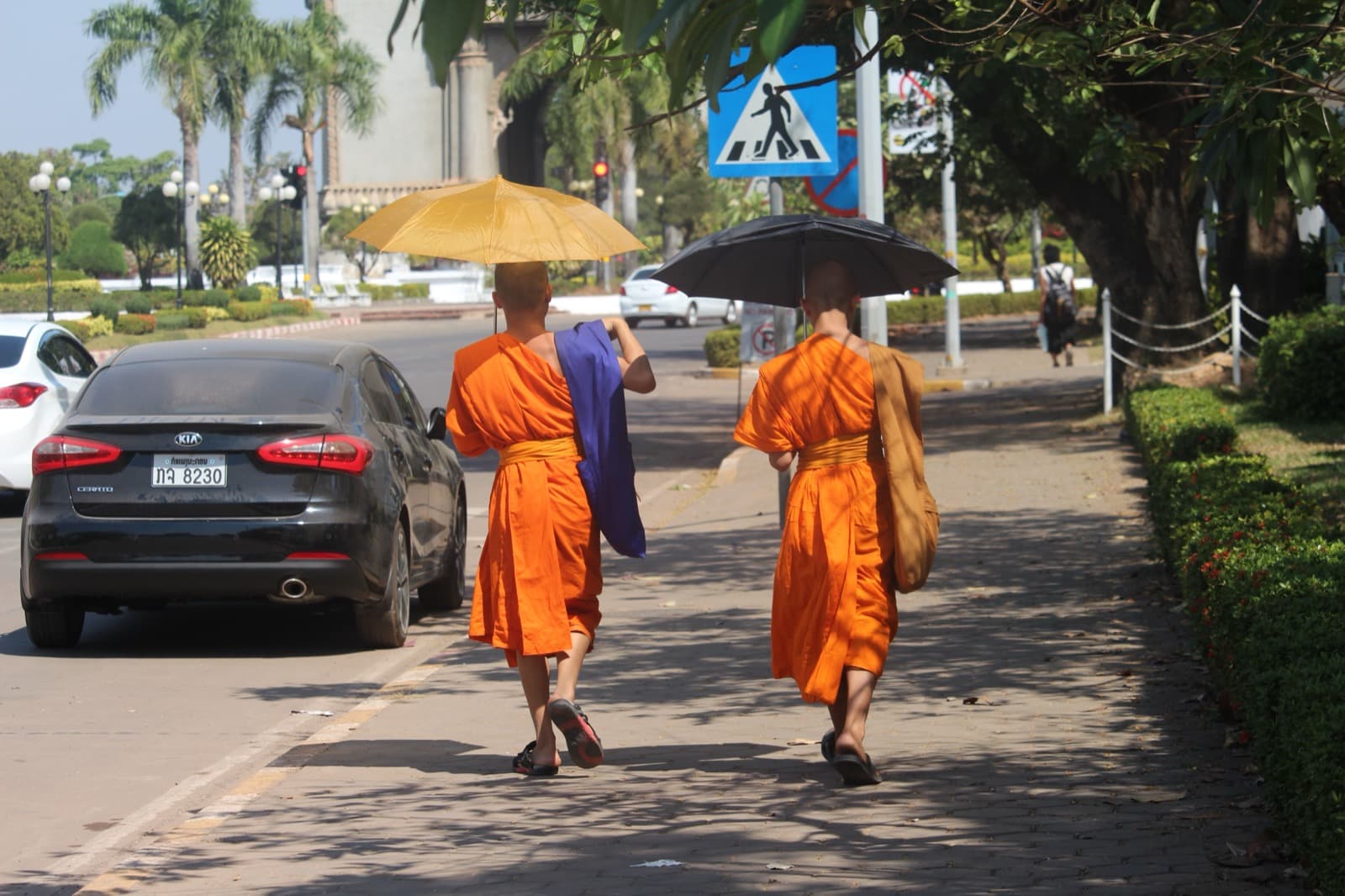
Laos is a Theravada Buddhist country, and a wat (temple) is a working place of worship before it is a sight. Pha That Luang, Wat Sisaket, and Ho Phra Keo in Vientiane welcome visitors, but they expect the same respect a local would show. The rules are simple and the same everywhere in the country.
Dress
Cover your shoulders and knees. Sleeveless tops, shorts, and short skirts are considered inappropriate, and some temples will turn you away or ask you to cover up. A light scarf or sarong in your bag solves this in seconds and doubles as sun protection. Remove hats and sunglasses inside buildings. Lao women traditionally wear the sinh, a wrap-around skirt, to temples; visitors are not expected to, but long, loose clothing is appreciated.
Shoes and feet
Take off your shoes before entering any temple building — look for the pile of shoes at the door. Feet are considered the lowest part of the body: never point them at a Buddha image or a monk, and do not step over anyone. When you sit on the floor, tuck your legs to one side or behind you rather than stretching them out. Do not touch anyone on the head, including children.
Buddha images
Do not climb on, sit on, or lean against Buddha images or stupas for photos, and do not turn your back to a Buddha image for a selfie. Do not point at them with your finger; gesture with an open hand if you must. Buddha images, including souvenirs, are meant to be treated with respect — placing one on the floor or using it as decoration in a bathroom causes real offence. Visible Buddha tattoos are frowned upon.
Monks
Monks are held in deep respect. Women should not touch a monk or hand anything directly to him; place the item down or pass it through a man. Do not sit higher than a monk, and lower your head slightly if you pass one. Speak quietly, and ask before photographing a monk up close.
The morning alms round (tak bat)
At dawn, monks walk in silent single file collecting food offerings from kneeling locals. It is best known in Luang Prabang but happens in Vientiane too. Watch from across the street, stay quiet, keep your distance, and never use a flash or step into the line. Only take part if you genuinely intend to make an offering, do it properly — buy sticky rice from a market rather than a tout, kneel, remove your shoes, and offer with your right hand — and remember it is a religious act, not a photo opportunity.
Inside the grounds
Keep your voice down and your phone on silent. Photography is usually allowed in the grounds and often inside the main hall, but look for signs and ask if unsure; some ordination halls are closed to women or to all visitors. Donation boxes are common and a small note is appreciated, though never required. Do not eat, smoke, or drink alcohol on temple grounds, and avoid public displays of affection.
Worth planning around
Boun That Luang, the festival at Pha That Luang, is the biggest religious festival in Vientiane and falls around the full moon in November. Expect processions, a candlelight wax-castle parade, and huge crowds. Temples are also busiest on Buddhist holy days, when locals come to make merit — a good time to see a wat in use, and a time to be extra discreet.