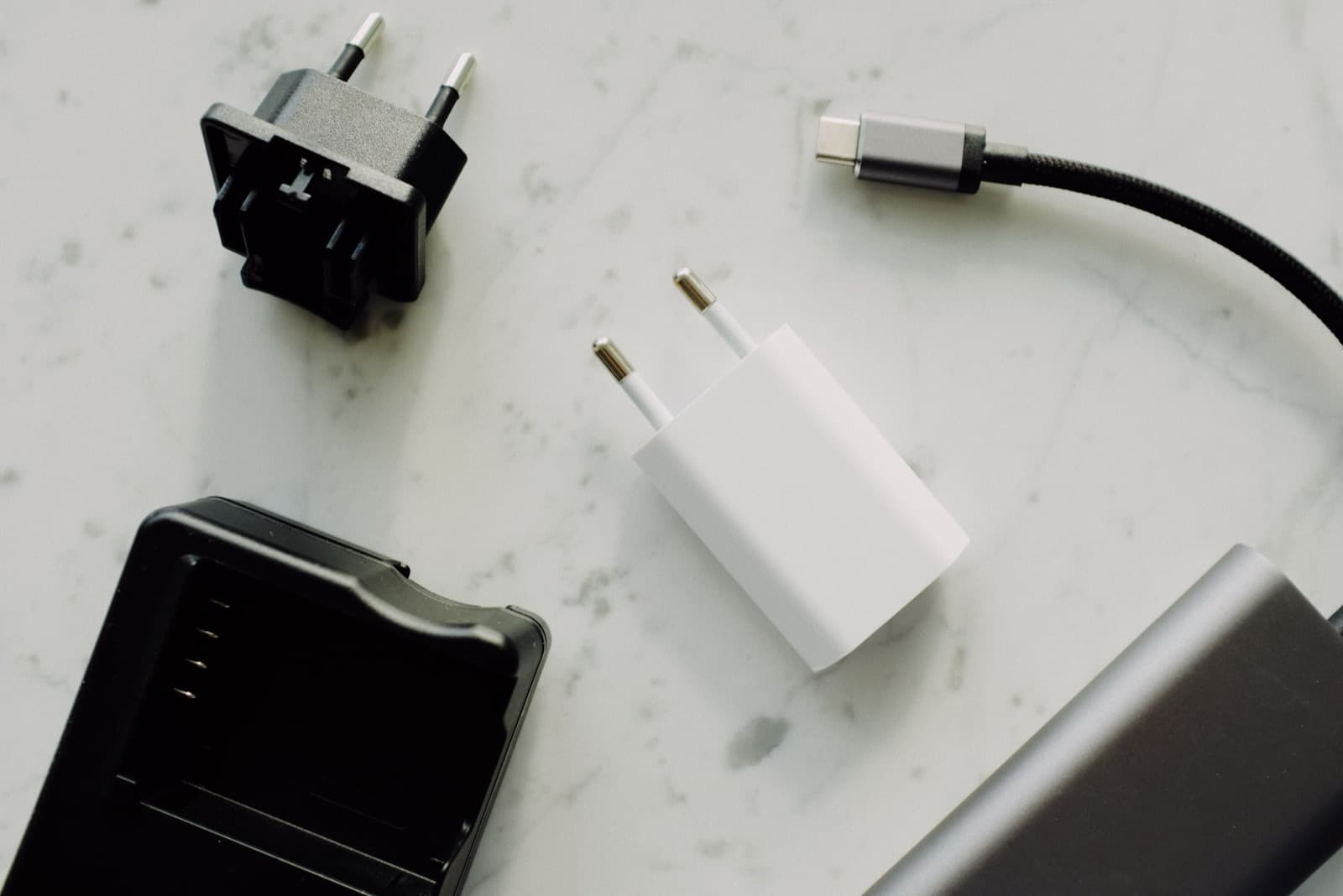
Laos will charge your phone and keep you online; it just does it slightly differently from home. A five-minute check before you pack saves buying an adapter at the airport.
Voltage: 230V, 50Hz
Laos uses 230 volts at 50 hertz, the same as most of Europe, Korea, Thailand, and Australia. If you are coming from a 100–120V country such as the United States, Canada, or Japan, look at the small print on each charger: almost all phone, laptop, and camera chargers say INPUT 100–240V and work anywhere with only a plug adapter. Hair dryers, straighteners, and other heating appliances often do not, and will burn out unless they are dual-voltage. Most hotels provide a hair dryer.
Plug shapes: A, B, C, E, and F
Sockets in Laos are a mix. The flat two-pin type A and three-pin type B (the North American shapes) are the most common, and the round two-pin types C, E, and F (European shapes) are also widespread. Many sockets are universal and accept several shapes. Even so, the safest move is a compact universal travel adapter, because the socket in your room may differ from the one in the lobby. Korean and European round plugs usually fit; British three-pin plugs always need an adapter.
Charging on the go
Older guesthouses may have only one or two sockets per room, often far from the bed. A multi-port USB charger and a power bank solve this. Keep power banks in your carry-on for flights, not checked luggage. Unstable voltage can occur, so charge sensitive electronics through your own charger rather than a cheap unbranded one from the market.
Wi-Fi: common but uneven
Hotels, guesthouses, cafés, and most restaurants in Vientiane and Vang Vieng offer free Wi-Fi. Speed and reliability vary greatly from building to building and drop sharply in the evening when everyone is online. Do not plan to rely on Wi-Fi alone for maps, ride-hailing, or messaging.
Mobile data: get a Lao SIM or eSIM
Mobile data in Laos is cheap and far more dependable than Wi-Fi. The main carriers are Unitel, Lao Telecom, ETL, and TPLUS, and tourist SIMs are sold at the airport arrivals counters and in town shops; bring your passport. If your phone supports eSIM, you can install one before you leave and be online the moment you land. Ride-hailing apps such as LOCA, QR payments, translation, and maps all need data, so this is the single most useful thing to set up on day one. Our SIM vs eSIM guide compares the two options.
Power cuts
Short, unannounced power cuts happen occasionally, more often outside city centres and in the hot season. They usually last minutes rather than hours. Keep your power bank charged and your phone's flashlight in mind, and download offline maps and your translation language pack in advance so a cut or a dead Wi-Fi router does not leave you stranded.
A packing checklist
Universal travel adapter; multi-port USB charger; power bank (in carry-on); dual-voltage or no heating appliances; offline maps downloaded; Lao SIM plan chosen or eSIM installed.